Y'know who sucks? Robert Johnson.
"Oh no he didn't!" I hear you say. And as I hear the rampaging feet of a hundreds "blues purists" brandishing pitchforks and lynch ropes coming towards me, let me deconstruct and hopefully destroy the cult of personality that is Robert Johnson.
Now, of course, the obsession with Robert Johnson is part of a greater issue I'd like to call the "Delta Blues Mystique". The Delta Blues Mystique is that element that is called upon by every indie band and post-punk band who wants to try and seem rootsy and authentic as well the element called upon by every half-assed singer/songwriter who want to sound "dark", "gritty" and "soulful". The Delta Blues Mystique is the modern conception of "the blues" which arose some time in the 60's and it is a horribly patronising and perhaps downright racist and offensive idea which was formulated by a lot of rich, educated student-types. Basically, it is the idea that old, black (ooooh, they've gotta be black) guitar-playing musicians, who are either poorly-educated or uneducated and who prelude every song they play by mumbling something incomprehensible while journalists nod on and pat them on the head for being such good boys...
I think this is the quintessential example:
Now, it is absolutely certain that the interviewer inquiring of Son House the nature and origin of "the blues" has written out his own idea of where "the blues" came from and has studying text books and musical theory and history to culminate this idea. And you know what? It's probably right! But it's probably not "authentic" whereas when Son House mumbles some cenile shite about "it's...it's...it's a feeeeeeling!" that's so freaking "authentic" that it must be worth writing down and sticking on some poxy BBC4 documentary. (Not that I'm dissing BBC4 documentaries in general - the Folk America series was really very good)
Ah, that word "authentic" which has done more harm to blues music than any other in history. It embodies The Delta Blues Mystique and signifies a hipster attitude and an artistic worth based on a supposed insight into the way poor, stupid people live - so rich bohemians can feel they're somehow in touch with a subculture that they are in no way a part of. It's not the music, it's the association/ I mean, have you ever heard anyone insult a country bluesman? Well, you're about to! Son House is crap - I mean, his playing is the equivilent of having a seisure while slapping an out-of-tune dobro. Ah, but it's REAL! And that's what counts!
Now, I must say that the Delta blue is not my thing - I prefer piedmont and atlanta styles which use complex fingerpicking and ragtime influences, as well as witty, hip lyrics and in-key singing. Buddy Moss, Blind Boy Fuller, Blind Blake, Blind Willie McTell and the rest of those fellas. But as far as I can tell, the reason that Delta Blues, which refers to the likes of Robert Johnson, Son House, Charlie Patton and Tommy Johnson, is the most famous and lauded genres of blues is because it's simplistic. It requires very little brains or skill to play or sing, is often completely tuneless or out-of-tune and the lyrics are repetative and moronically simple. Which is, apparently, more "authentic".
This is where the root of the "authentic" issue comes from. Take a guy like Louis Armstrong and put him up against Son House. Why is Son House "authentic" while Louis Armstrong is not? They both came from the same poor backgrounds, both born around the same time (Louis Armstrong was actually one year older), both black and from the South. The difference? Louis went and learned to play an instrument, joined bands, innovated new musical ideas, learnt to read sheet music, played with a studied complexity and combined his own knowledge of folk music with modernistic ideas. While Son House sat and banged out the same out crap for 86 years without changing an iota.
All of which brings me back to Robert Johnson. Well, everything I said about Son House applies to Johnson too, but there is a lot more to it. For me, there is nothing more irritating than seeing endless 100 Best Guitarists lists online and in magazines filled to brim with the usual wankers like Slash, Jimmy Page, Eddie Van Halen and Eric Clapton and then stuck somewhere around the middle, Robert Johnson. It's ridiculous. Not just because Robert Johnson wasn't a very good guitarist, but because his style has nothing in common with anyone else in that list and you know he's only been placed as a point of hipster recognition. "Oh yes, we loooove Robert Johnson, he's sooooo dark and real! You know he sold his soul to the devil?!" Yeah, yeah, we all know he sold his soul to the devil and magically became an ingenious guitarist...in fact, more people know this than have ever even heard his recordings. More than anything it's this that embodies the Delta Blues Mystique. There is nothing special about Robert Johnson - in fact, he's not particularly good a guitarist at all. The likes of "If I Had Possession Over Judgement Day" could be played by someone who'd had about a week of guitar lessons. What counts is the hype.
Now, I must say, it's not entirely due to ignorance that Robert Johnson is so well known. When the album "King of the Delta Blues Singers" was released in 1961 it was for a lot of people, particularly in Britain, the only easily available country blues album and with the blues/folk revival kicking off it's hardly suprising that people ranted and raved about Robert Johnson in the absence of anything else. Still, that's not a complete excuse and it's certainly no excuse nowadays in this age of internet where people can find out about far superior (and far more enjoyable) blues musicians like Blind Blake, Peg Leg Howell, Bessie Smith and so on...it's all at your fingertips.
I'm not exactly one for shirking ideas of "authenticity", I would quickly mentioned. Or to put it another way, I do think that age does add value to music; surviving the ravages of time and changing culture is difficult and older music adds insight into a vanished period and provides a point-of-view and inspiration which simply can no longer exist. But that must be merely a part of it, rather than the main drive. And it often ends in hypocrisy - what's more "authentic", "Oh Susanna" or "Crossroads Blues"?
Stupid question.
Showing posts with label blues. Show all posts
Showing posts with label blues. Show all posts
Tuesday, 24 August 2010

Wednesday, 21 April 2010
American Artist No. 4: Uncle Dave Macon

This post has been a long time coming - Uncle Dave Macon has come up a lot in my blog posts and I do keep saying that he needs his own post - well here it is!
Uncle Dave Macon was perhaps the most influential, popular and important folksinger of the first half of the 20th century. He was known as the King of the Hillbillies (also the Dixie Dewdrop) and was consistently popular from his first single in 1924 up until his death in 1952. He was one of the very first performers on the Grand Ole Opry radio show in 1925 and people have been imitating his style, vocals, banjo-playing up to this day.
So what's the deal with Uncle Dave? Well there's a few point:
1. Age - Dave Macon was born in 1870. Think about that. It means he was born only 5 years after the end of the civil war and was a full grown adult in Victorian times. He didn't record until he was in his fifties and, as such, he gives a better insight into the folk music of the 19th century than pretty much any other perfomer - most folksingers only give their interpretations of 19th century music, Uncle Dave was actually there! He was older than any of the blues singers, older than Leadbelly, older than recorded music itself. Many of the songs which have become so well known as to merge into the public consciousness were probably written while he was adult and that's something to think about.
2. Wildness - Uncle Dave opitimised the "crazy old guy" persona. On most of his records he screams, hollers, whoops and howls out the lyrics with a reckless abandon and often the sound of him stomping his feet on the floor of the recording studio can be heard. His attitude towards folk music was at the complete opposite end from the bombastic pretentious nonsense that so many people now like to churn out. His music was wilder, faster and noisier than your average hardcore punk band and rocked mercilessly.
3. Repetoire - He had one of the widest ranging repetoires of any folk singer. Just take a look at the nine CD boxset, "Keep My Skillet Good and Greasy" and marvel at the sheer number of songs he knew and recorded. What's even more remarkable is the diversity. He played hillbilly, appalachian, proto-blues, minstrel songs, coon songs, vaudeville, cakewalks, spirituals, comic numbers and more. He played songs by both black and white musicians - some of which can be a bit, er, racially charged by today's standards. He had no qualms about using words like "nigger", "darkie" and "coon" and sometimes it can be a bit discomforting to listen to songs like "New Coon in Town" and "Run, Nigger, Run" - a song which was, ironically, originally sung by black slaves. He was, however, a man of his time; there no genuinely malicious intent behind these words, like if someone used them in today's society - the man was born in 1870 for christ's sake, concepts like racial sensitivity didn't even exist then. Not to mention he often gives kudos to the black folks at the beginning of some his songs - I dunno, it's these seeming contradictions that make the music that much more interesting.
Still, you really can't get the point about Uncle Dave until you hear his recordings - the song "Way Down the Old Plank Road", released in 1925, is probably his most famous song as it was included on Harry Smith's Anthology of American Folk Music. And what a song it is - this is the recording that turned me forever onto the path of the old music and just listen to it and you'll know why:
Rockin' stuff. Uncle Dave's first single was "Keep My Skillet Good and Greasy" backed with "Hill Billie Blues", one of the first uses of the word "hillbilly". Most of Uncle Dave's early singles were just him by himself on banjo and, recorded before the 1926 advent of electrical recording, can sound a bit hollow, although his charisma still shines through the tinniness. In 1925 he teamed up with legendary country guitarist Sam McGee - who will also need a page of his own later - and expanded his sound to guitar and banjo in unison, with the guitar providing bass behind the banjo. These recording are where he really began to take off - other than "Way Down the Old Plank Road" he also recorded the negro spiritual "Poor Sinners, Fare You Well", the railroad classic "John Henry", crazy stomper "Whoop 'Em Up Cindy" and even dropped the banjo for "I've Got The Mourning Blues" in which Sam McGee plays some fingerstyle guitar in Open-D tuning. Here's "John Henry" in case you're one of the strange people who doesn't know this song - beginning, like many Uncle Dave records, with one of his peculiar monologues:
He expanded the line-up even further the following year adding Sam's brother Kirk on banjo and fiddle and Mazy Todd on fiddle to form the Fruit Jar Drinkers, who became the premiere string band of the 1920's. Their recordings are among the best recordings ever - I have already played "Sail Away Ladies" on an earlier blog, but screw it, I'm gonna play it again:
Perfection in music form. Another good recording from this era is "Jordan Am A Hard Road To Travel" a cover of Dan Emmett's 1853 mock-spiritual with heavily altered lyrics:
One of Uncle Dave's main points were political messages he often stuck in his songs - the above song, with lines like
I don't know, but I believe I'm right, the auto'll ruin the country,
Let's go back to the horse and buggy and try to save some money.
Before starting into music, Dave ran a horse and buggy business which collapsed due to the introduction of the horseless carriage - yeah, he's THAT old - and many of his songs have a personal beef with cars and, in particular, Henry Ford, who gets digged in the above song too.
Another, more explicitly political song of his is "Buddy, Won't You Roll Down the Line", which deals with a mining company leasing convicts to work in the mines and how free labour rebelled against this:
Way down yonder in Tennesee, they leased the convicts out
To work in the coal mines, against free labor South;
Free labor rebelled against it. To win it took some time.
But while the lease was in effect, they made 'em rise and shine.
BTW, the number of Uncle Dave Macon songs on YouTube is bloody disgraceful - it barely scratches the surface.
Anyhoo, another good example of his political style is "Wreck of the Tennessee Gravy Train". Recorded solo in 1930, the song deals with a scandal involving Henry Horton, the governer of Tennessee and the collapse of the Caldwell Company Bank in Tennessee, leaving the state $6 million in debt.
Uncle Dave kept going and touring with the Grand Ole Opry until basically the end of his life - he was beloved by everyone from his fellow old-timers, to the new breed of Bluegrass musicians, to the folkies of the 50's folk revival. In 1940, he appeared in the film "The Grand Ole Opry Movie". Here's a clip of him raving it up with his son, Dorris:
As well as a more crazed scene of him and bunch of other Opry stars playing something which sounds a bit like "Soldier's Joy":
The legacy of Uncle Dave Macon in today's day and age is that he essentially embodies the entire period of folk from after the end of the Civil War, post-Stephen Foster and post-Dan Emmett, up until the beginning of modern country music like the Carter Family their ilk. He presents folk music as it once was and, still often is, and always should be - loud, raucous, wild, accessible, moving, eccentric and unpretentious. So there!
Some of his stuff can be found on the Internet Archive, but if you're further interested, I highly recommend the boxset "Keep My Skillet Good and Greasy" which contains all his recordings. You can buy it or otherwise type it into google and see what happens...
Peng...
Tuesday, 16 February 2010
On to more Spiritual matters...

No-one would deny that Christianity has contributed a huge amount to musical culture of the world. Afterall, written music has its origins there and hymns have made up most of the backbone of modern music. Still, I personally believe that the negro spiritual has been the best expression of christianity through music. Maybe its the simple unpretentiousness of them or their association with slavery - thus lending a certain authenticity to the messages and morals - or maybe, I dunno, I just don't like white people's religious music. Regardless, they make up one of the greatest repetoires of folk songs in history and are perhaps more important than any other genre of the 18th and 19th century.
Actually, I'm going to start this post with a song that was not originally a negro spiritual, or even an American song, but which was later inaliably identified with the genre. That song is, of course, "Amazing Grace".
Now if you're one of those genuinely strange people who doesn't know this song, here's a recording by Judy Collins from the early 70's. Generally, I don't like Judy Collins, because she represents a horribly, horribly polished and fake branch of so-called "folk music", but her recording of this, backed by a choir, is pretty perfect:
"Amazing Grace" is one of the oldest songs I'll be dealing with on this blog,it was published in 1779 by ex-slave trader John Newton. This is significant - there were absolutely shiteloads of hymns written in the 17th and 18th century and if we were simply dealing with Christian hymns that influenced negro spirituals I could come up with any number by the likes of Isaac Watts. What makes "Amazing Grace" significant is that it was written by an ex-slave trade trader in (allegedly) a fit of religious and moral guilt over his profession and the song became something of an anthem for the whole abolitionist movement and later for enslaved African-Americans.

The symbol used by the Quakers and other abolitionists in Britain in the 18th century - "Am I not a man and a brother?"
Ironically, this most theistically uplifting of musical genres grew out of cultural opression and repression - when African slaves were brought to America, all elements of their African culture and heritage was obliterated; they were all brought under the arm of Christianity and had any attempts at breaking into African songs or rituals forcefully beaten out of them. When sitting in church, benches would be pushed close together to prevent the slaves from getting up and dancing.
To quote negrospirituals.com:
Rural slaves used to stay after the regular worship services, in churches or in plantation “praise houses”, for singing and dancing. But, slaveholders did not allow dancing and playing drums, as usual in Africa. They also had meetings at secret places (“camp meetings”, “bush meetings”), because they needed to meet one another and share their joys, pains and hopes. In rural meetings, thousands slaves were gathered and listened to itinerant preachers, and sang spirituals, for hours. In the late 1700s, they sang the precursors of spirituals, which were called “corn ditties”.
However, the very basis of Christianity condemns slavery as a sin and it is this fact that eventually made Christianity the enemy of slavery and a tool for its abolition. Trying to provide a timeline for negro spirituals is practically impossible, since, even compared to white folk songs, documentation of the songs is practically non-existant. However, there were a few books published in the mid 19th century that were collections of negro slave songs, often including spirituals, the first and most significant being "Slave Songs Of The United States" in 1867.

If you want to actually read the book, here's a full scan of it:
http://docsouth.unc.edu/church/allen/allen.html
Not a lot of the songs documented are that well known today, but there are a few that are pretty famous. The most famous is probably "Michael, Row The Boat Ashore". It was big during the American 1960's folk revival and, as such, here's a version by Pete Seeger from 1963:
Pete can get on my tits sometimes with his often patronising attitude, but this is pretty cool. Another well known song from the book is "Nobody Knows the Trouble I Seen", sung here by legendary "voice of God" Paul Robeson:
One of the most popular and lasting negro spirituals is "Go Down, Moses", also known as "Let My People Go". Unlike a lot of spirituals, the song is not jubilant and uplifting, but sombre and ominous - the song's relevance has no doubt been emphasised due to the obvious parallels made between the plight of the Israelites and African-American slaves. I mean, it is one of the few slave songs that actually contains the phrase "Let my people go" and so has been put forward as one of the great songs of defiance and determination. The song was first published in 1872 by the Fisk Jubilee Singers, the premiere black vocal group of the era, but some sources have dated the song as having been sung as early as 1853. One of the best versions of the song is from Preston Sturges' 1941 existentialist screwball comedy, "Sullivan's Travels":
Probably the most famous negro spiritual is "Swing Low, Sweet Chariot". Interestingly, the song had an official author, Wallis Willis, a freedman (newly emancipated slave) who composed the song sometime before 1862. Whether he based it on an earlier song he had heard or actually thought it up himself doesn't really matter, though - the song became basically the anthem for African-Americans and arguably remains so until this day, although I'd like to suggest it has more universal status. It has been suggested that the lyrics to the song referenced the "underground railroad", the secret means for slaves to escape to the freed states. It was popularised by the Fisk Jubilee Singers starting in the 1870's and took from there. If, somehow, you haven't actually heard this song, you're probably sectioned. But still, here's a version by vocalist(and clearly a massive Paul Robeson fan) Kevin Maynor. Trying to find decent versions of this song is hard, bytheway, because almost all the versions I see are either "clever reinterpretations" (shite) or sung by overdramatic "soulful" singers (really shite):
After the abolition of slavery, the most famous singers of negro spirituals were the Fisk Jubilee Singers, a group of African-American students from Fisk University who formed in 1871 as something of reaction against the blackface minstrel shows who claimed to bring the "authentic" sound of the freed black slaves to the stage.

The Fisk Singers were an acapella vocal group whose dignified and, admittedly, middle-class renditions of negro songs (and a few Stephen Foster songs) provoked both praise and criticism across America and Europe. Probably for the same reason in both cases - they didn't confirmed to the stereotyped image of blacks that had been instilled in people's minds. They still exist today as a group, albeit (shockingly) with none of the original members; it is something of a tradition in Fisk University. The original Fisk singers made recordings as early as the turn of the century, but they often sound very old and creaky today. A lot of them can be found public domain on the internet, but here's a very good recording made in 1926 of "Keep A' Inchin' Along":
With the birth of various new recording markets, spirituals became widely spread throughout popular culture. Even genres like the supposedly Satanic medium of the blues and the supposedly white-washed country music recorded a lot of negro spirituals.
Artists like Blind Willie Johnson and the Reverend Gary Davis who were usually (and inaccurately) labelled as country blues artists had repetoire composed almost entirely of religious material, albeit played with a bluesy, raggy guitar accompaniment. Here's Reverend Gary Davis playing "Children of Zion" and looking badass on Pete Seeger's Rainbow Quest in the mid 1960's:
And take this beautiful version of "All God's Chillun Got Wings" by cowboy vocal group, the Sons Of The Pioneers - a great defence against the percieved image of country music as white washed or racist:
In the 1940's, Thomas A. Dorsey combined the negro spiritual with jazz, R&B and pop influences and created gospel music. Gospel music is often thought of as interchangable with the negro spiritual, but it really is a very different kind of music - take a listen to this recording of the Golden Gate Quartet, one of the most popular gospel groups of the 30',s 40's and 50's singing the negro spiritual, "Joshua Fit The Battle" in the gospel style:
Of course, in the 20th century, negro spirituals had their biggest revival during the civil rights movements, but that's really an issue for another time....
Twang goose, muds!
Wednesday, 3 February 2010
American Artist No. 2: Blind Blake

You know, there's a very typical image of the bluesman in most people's heads. That of the haggered old guy, dressed in dusty dungerees, sitting on a porch swing, banging out some amelodic 3 chord drone and wailing in an off-key voice about the devil, death and his "baby" her various weelings and dealings.
Yeah? Well, Blind Blake is NOTHING like that. Blind Blake represents the other side of the bluesman spectrum - dressed up sharp, singing often-witty lyrics over the maybe the most stunning guitar playing ever put on record. Look, he's fecking smiling in that photo!
Nothing is really known about Blind Blake. The photo above is the only one ever discovered. Some people have suggested he came from the Gullah (or Geechie) communities of South Carolina, since on one of his records he starts using the dialect, but this has never been confirmed. Even his real name was never sure - on another record he actually states his name is "Blind Arthur Blake", but some have suggested his last name was actually "Phelps" and that "Blake" was a nickname denoting a "hard-ass". He was probably born circa 1893 and is thought to have died sometime in the 1930's, although this has never been proven, either. He was, along with Blind Lemon Jefferson, the best-selling blues artist of the 1920's and, unlike Blind Lemon Jefferson, it's not hard to see why - his records are catchy, witty, cool and jaw-droppingly complex.
Blake played blues, but he equally often played ragtime, pop songs, jazz and even a British music hall number (sort of). He is often considered the Father of Ragtime Guitar - he pioneered an incredibly complex method of fingerpicking which is maybe, to this day, the most innovative and complex ever recorded outside of the most advanced flamenco or classical guitarists and while many people (including myself) have attempted to imitate it, none have ever succeeded. At the time, adverts referred to it as his "piano-sound guitar" and that's basically what it is. Take this recording, "Skeedle Loo Doo Blues" from 1926, as a quintessential example of his ragtime style - the name is probably just for marketing purposes, as the song is most certainly ragtime:
That's one guy with one guitar and yet somehow he manages to play bass, rhythm and lead all at the same time. Perhaps the thing that makes Blake so amazing is his bass lines - whereas even other blues fingers just use an alternating bass with their thumbs (bum-bum, bum-bum, one two, one two, you get the idea) Blake seems to actually create a whole seperate melody with his thumb, while engaging in stunning improvisational playing with his forefingers.
His first record release was "West Coast Blues" backed with "Early Morning Blues" in1926. "West Coast Blues" is another ragtime piece, while "Early Morning Blues" is a genuine blues song. It begins the long line of casually misogynistic songs in which he cheerfully extols the joy of shooting your woman:
The record was a hit and things just kept flowing for him. One thing I'd like to point out about Blake was that he was not really a "country blues" artist, but much more of an urban musician compared to the likes of Blind Lemon Jefferson or Blind Willie McTell.. As such, there are no folk songs in his repetoire and he has a much more heavy jazz influence. On his 1928 record, "Southbound Rag", he is joined by jazz clarinetist (and Louis Armstrong regular), Johnny Dodds:
Maybe his biggest hit, and most well known song, is "Diddie Wah Diddie" from 1928. This is his blues-pop masterpiece - it's a blues in structure, but the song itself is so catchy, bouncy, fun and yet intricate and filled with some of his most jaw-dropping instrumental passages that you could hardly imagine the likes of Robert Johnson covering it:
There's so much I could post for Blind Blake but it would be overwhelming - a really good article on him can be found here: http://www.gracyk.com/blake1.shtml
The main thing about Blind Blake - and the main reason he's not so well known today, except by guitarists - is that he never, EVER fits the patronising bluesman stereotype that was formulated during the 1960's. You can't put him up a symbol of how hard black people had it in the 1920's and how they express the suffering of the negro people through song. Blind Blake was not about suffering or misery. He was about the fun times, the jazz times, he was the spirit of the Roaring Twenties. He came, he made a lot of records, he sold a lot of records and then dissappeared leaving a legacy which those people who really appreciate good music and incredible guitar-playing have treasured and which those pretentious twats who only want their bluesmen to be simplistic, god-fearing, miserablist dumb-asses in order to appease their own elitist insecurites have ignored.
Blind Blake was the man. To finish, here's me playing one of his classic ragtime-pop hits, "That'll Never Happen No More":
Shang goose, cruds!
Sunday, 31 January 2010
American Artist No. 1: Jelly Roll Morton
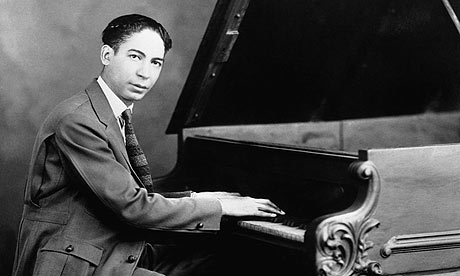
A lot of people have laid claim to the title King of Jazz: Buddy Bolden, its supposed father, Freddie Keppard, his successor, Nick LaRocca, the first man to record it and Paul Whiteman, the first man to introduce to a large white audience. Still, as far I'm concerned, in the 1920's there were only two men who could really lay claim to the title: Louis Armstrong and Jelly Roll Morton.
Jelly Roll Morton was a New Orleans pianist, whose real name was Ferdinand Joseph LaMothe. Born in 1884 (or 1889 as some sources state) into a Creole community, he was surrounded by the sounds of gospel, early blues, ragtime and folk songs that made up the rich culture of New Orleans at the time. By the age of 14, influenced by the likes of Scott Joplin, Buddy Bolden and Tony Jackson, he was playing in brothels to earn his keep and became regarded as one of the best pianists in Storyville (the New Orleans red light district). In 1904 he joined a travelling minstrel show and set out across America.
Jelly Roll Morton was the first true Jazz composer. In 1915, he published the sheet music for what is arguably the first Jazz song ever written, "The Original Jelly Roll Blues" - it is a pretty incredible composition, with elements of ragtime, blues with, as Jelly Roll called it, the "Spanish tinge" but not really sounding like any of them; the very essence of Jazz. Although Jazz musicians had existed before this, the publication of "The Original Jelly Roll Blues" marked the first time that Jazz was introduced into any kind of mainstream culture.

Here was something really new - Jelly Roll Morton was an educated musician who was steeped in traditional music and amalgamated all his influences into a truly modern music which go onto become America's greatest musical artform. Everything that happened after, from Dixieland to Swing, to Big Band, to Boogie, to Bebop, to Jump Blues, to Rock 'n Roll, to Free Jazz and so on, could not have happened with out "The Original Jelly Roll Blues". Here's a recording by pianist Jim Hession:
Ironically, for all this, Jelly Roll Morton didn't make any recordings until 1923 and these were a mixture of piano solos and band recordings. The piano recordings are interesting for historical purposes, but this was before the advent of electrical recording, which occured around 1926, and so the recordings are very tinny and not particularly enjoyable. The same goes for the band recordings, which are even worse - he didn't have a real band at the time and they sound bland and uninspired.
Jelly Roll must realised this himself, because in 1926 he put together his Red Hot Peppers, one of the best Jazz bands of the era. Less jammy then earlier Jazz bands like King Olivers and less improvisational than Louis Armstrong's Hot Fives, the Red Hot Peppers were tight-as-a-pussy-cat, virtuoistic, but wild and uninhibited. Featuring the great Kid Ory on trombone and Johnny St. Cyr on banjo among others, there recordings are also some of the best sounding too - he must have shelled out for better recording equipment. One of their best recordings is "Black Bottom Stomp" from 1926 - a wild dance number which features every band member going at it like a muthah, but through which the compositional genius of Jelly Roll Morton (who is on piano) shines through:
They all so recorded a full band arrangement of the "The Original Jelly Roll Blues" which is not only a brilliant recording, but which is a great example of how Jelly Roll Morton was able to transpose his piano playing into an ensemble arrangement:
The Red Hot Peppers made a lot of great recordings until he disbanded them in 1930. Jelly Roll Morton lay low for most of the 1930's - his Hot style of Jazz was being replaced by the smoother sound of the Big Bands and Swing. Although he did record intermittently in the 1930's, his most important recordings were with legendary folklorist Alan Lomax in 1938, for the library of congress. Not released for decades, Alan Lomax made hours and hours of recordings of Jelly Roll discussing Jazz, Ragtime, New Orleans, folk music, classical music and anything else that came to mind.

During these sessions, he got a bit tipsy and recorded a few "dirty" songs, which he had played in brothels in New Orleans back in the 19th century, but which until then he had no hope of recording. They're interesting simply because they prove that this kind of language was not invented in the 70's. Take this recording of "Dirty Dozen" which includes massive amounts of expletives as well as homosexuality, bestiality and whatever other fun things he could think of:
Lovely stuff. Less abrasive perhaps, was his recording of the traditional blues song, "Hesitation Blues":
Around 1939, he put together another band, his New Orleans Jazzmen and recorded a number of more bluesy, more vocals-based songs. They were not commercially successful, but they are very good. He recorded two of his most covered songs during this session, the "Funky Butt" update, "Buddy Bolden's Blues" and "Winin' Boy Blues":
Jelly Roll Morton died in 1941 from complications involving asthma. In later years he gained reputation as a bit of an arrogant bastard - claiming to have invented Jazz in 1902 and slagging of W.C. Handy in a magazine, he gained an image of a man bitter at what he saw as not getting his dues. Well, Jelly Roll Morton may not have invented Jazz outright, but he was probably it most influential proponent and the man who turned it into a genuine artform. He was to Jazz what Scott Joplin was to Ragtime and W.C. Handy was to the Blues. Not to mention that, unlike either of these two, he was also one of its great performers and his Red Hot Pepper recordings are essentially flawless.
Chang goose, muds...
Friday, 29 January 2010
The Blues Ain't Nothing But...
Now we come to a controversial subject: the blues. There is no genre in American music more degraded, misinterpreted, over-mystified and abused than that of the BLUES. Nowadays, the term "blues" has been used to describe everything from George Gershwin to the White Stripes. And is there any sight more vomit-inducing that seeing a bunch of middle-class art student sitting around in a coffee bar talking about how much they bloody love Robert Johnson and Son House and the sheer "darkness" and "suffering of the negro people" and whatnot...

Look, the main thing to understand about "blues" is that there are really two types of blues. One type of blues refers to folk songs being sung since the 19th century dealing with tragedy, world-weariness and sexual conquest and lots of other fun things - the other type of "blues" refers an actual musical structure involving an 8, 12 or 16 bar system of "blue notes" and flattened sevenths and so on, which was solidified around the beginning of the 20th century by musicians like W.C. Handy and Hart Wand. More often than not these two definitions overlap, of course.

W.C. Handy is most often referred to as the Father of the Blues. Now this is of course a fairly bollocks term - W.C. Handy neither invented the blues, which had been sung among negro communities for years, nor was even the first man to publish a blues song (That was Hart Wand's "Dallas Blues" in 1912). He was, however, the man who did the most create the idea of the blues as a musical form and a respectable art form - he played a role in relation to the blues, that was similar to that played by Robert Burns in relation to Scottish folk music; he was a collecter and adapter of songs. His first published song was the "Memphis Blues" in 1914 - this song is not a blues song throughout; more like half-blues, half-ragtime. Here's a recording by pianist Jim Hession:
The blues first found its popularity in the vaudeville circuits - many of the songs sung in the 1910's with the label "blues" were not actually blues in the musical sense, even if they did often emulate some of the style. Perhaps the first blues hit recording was Marion Harris' 1920 version of W.C. Handy's 1916 "St. Louis Blues". The "St. Louis Blues" is W.C. Handy's masterpiece and one the truly great American songs. It was, for a long time, the most recorded song in the world and if W.C. Handy is remembered for nothing else, it will be this he is remembered for. The song IS a blues, but it opens with a habanera rhythm which repeated halfway through the song. And the lyrics are as iconic as it gets. I could play Marrion Harris' version of the song, but I don't think it really gets the power of the song across, even if it is quite a good version. The best version of the song is probably Louis Armstrong's 1954 recording - 8 minutes long and loud as feck, it is severely awesome:
The first recording of the blues by an African-American vocalist was Mamie Smith's 1920 recording of "Crazy Blues" and it was perhaps the most influential recording in American history - after it became a hit, record companies realised they could make money from "race records" and so the floodgate was opened for every African-American muscian who has recorded up to this day. The song itself is very much vaudeville-styled blues and Mamie Smith was no genius, but still, it's interesting:
After Mamie Smith, came Ma Rainey, who had actually been singing blues since 1902 and was known as the Mother of the Blues and Bessie Smith, by far the most popular female blues singer of the era, known as the Empress of the Blues. Here's her 1927 recording of "After You've Gone":
Another market soon opened up: country blues. Rural blues musicians, usually either pianists or guitarists, started getting recorded by the bucketload. The first country blues recording was "Guitar Blues" by Sylvester Weaver in 1923, but to be honest, it's shit - the B-side, "Guitar Rag" is much better, but its not blues, although it is the first recording of slide guitar on record. I can't seem to find it on YouTube (only the 1927 re-recording), though. He was followed by one Blind Lemon Jefferson in 1925 - the most popular country blues musician of his era. Listening today, it's hard to tell why Blind Lemon Jefferson was so popular. His music is atonal, amelodic, almost rhythm free and dark and depressing. Yet somehow he was the most popular. Another factor is that his records have been preserved terribly - they are worst-sounding quality of any music from the era. As such, his enjoyment is a bit tricky, but here's one of his more listenable recordings from 1927:
Yeah. Perhaps a less challenging, still awesome example of country blues can be found in Blind Willie McTell. Blues was just one of the many genres that Blind Willie McTell was proficient in - he could do ragtime, folk, gospel - but he could plays the blues like a bitch, too. His most famous song is "Statesboro Blues" because it was covered by the Allman Brothers *makes wanking motion with hand*, but here's another classic song - a 16 bar blues called "Searching the Desert for the Blues:
Now, the main problem that arose with country blues musicians - and one that still exists today - is that there was a lot of genre segregation. Basically, if they're black they're labelled as blues, if they're white they're labelled as country. The fact is, the repetoires of both black and white musicians was not radically different at all - blacks played country songs and whites played blues song. It's just that the recording companies found it easier to market artists through these simple labels. Take Mississippi John Hurt - he only recorded one genuine blues song in the 1920's and he's labelled as a "bluesman" when he's really a country singer. Listen to this:
He was also MUCH better recorded and preserved than Blind Lemon, too. I suppose this goes back to my first paragraph about the two kinds of blues - this is the kind of blues that existed before a musical structure was applied to it by various composers. Still, there are some cases where the labelling is simply idiotic - case in point, Jimmie Rogders. Jimmie Rodgers is known as the "Father of Country Music" which is utter bollocks, because, firstly, country music existed long before him and, secondly, 80% of his music is blues. His most famous song is "Blue Yodel No. 1" from 1927 and it's a genuine blues in both style and form:
Don't get wrong, I love Jimmie Rodgers, but the only reason he's labelled as country is because he's white. And the only reason Mississippi John Hurt is labelled blues is because he's black. That's still how it works today.
There's a LOT more to the blues than just what I've said here, but I'll need to go into various sub-categories and regional styles to describe it, which I'll do in future.
Rang juice, floods!

Look, the main thing to understand about "blues" is that there are really two types of blues. One type of blues refers to folk songs being sung since the 19th century dealing with tragedy, world-weariness and sexual conquest and lots of other fun things - the other type of "blues" refers an actual musical structure involving an 8, 12 or 16 bar system of "blue notes" and flattened sevenths and so on, which was solidified around the beginning of the 20th century by musicians like W.C. Handy and Hart Wand. More often than not these two definitions overlap, of course.

W.C. Handy is most often referred to as the Father of the Blues. Now this is of course a fairly bollocks term - W.C. Handy neither invented the blues, which had been sung among negro communities for years, nor was even the first man to publish a blues song (That was Hart Wand's "Dallas Blues" in 1912). He was, however, the man who did the most create the idea of the blues as a musical form and a respectable art form - he played a role in relation to the blues, that was similar to that played by Robert Burns in relation to Scottish folk music; he was a collecter and adapter of songs. His first published song was the "Memphis Blues" in 1914 - this song is not a blues song throughout; more like half-blues, half-ragtime. Here's a recording by pianist Jim Hession:
The blues first found its popularity in the vaudeville circuits - many of the songs sung in the 1910's with the label "blues" were not actually blues in the musical sense, even if they did often emulate some of the style. Perhaps the first blues hit recording was Marion Harris' 1920 version of W.C. Handy's 1916 "St. Louis Blues". The "St. Louis Blues" is W.C. Handy's masterpiece and one the truly great American songs. It was, for a long time, the most recorded song in the world and if W.C. Handy is remembered for nothing else, it will be this he is remembered for. The song IS a blues, but it opens with a habanera rhythm which repeated halfway through the song. And the lyrics are as iconic as it gets. I could play Marrion Harris' version of the song, but I don't think it really gets the power of the song across, even if it is quite a good version. The best version of the song is probably Louis Armstrong's 1954 recording - 8 minutes long and loud as feck, it is severely awesome:
The first recording of the blues by an African-American vocalist was Mamie Smith's 1920 recording of "Crazy Blues" and it was perhaps the most influential recording in American history - after it became a hit, record companies realised they could make money from "race records" and so the floodgate was opened for every African-American muscian who has recorded up to this day. The song itself is very much vaudeville-styled blues and Mamie Smith was no genius, but still, it's interesting:
After Mamie Smith, came Ma Rainey, who had actually been singing blues since 1902 and was known as the Mother of the Blues and Bessie Smith, by far the most popular female blues singer of the era, known as the Empress of the Blues. Here's her 1927 recording of "After You've Gone":
Another market soon opened up: country blues. Rural blues musicians, usually either pianists or guitarists, started getting recorded by the bucketload. The first country blues recording was "Guitar Blues" by Sylvester Weaver in 1923, but to be honest, it's shit - the B-side, "Guitar Rag" is much better, but its not blues, although it is the first recording of slide guitar on record. I can't seem to find it on YouTube (only the 1927 re-recording), though. He was followed by one Blind Lemon Jefferson in 1925 - the most popular country blues musician of his era. Listening today, it's hard to tell why Blind Lemon Jefferson was so popular. His music is atonal, amelodic, almost rhythm free and dark and depressing. Yet somehow he was the most popular. Another factor is that his records have been preserved terribly - they are worst-sounding quality of any music from the era. As such, his enjoyment is a bit tricky, but here's one of his more listenable recordings from 1927:
Yeah. Perhaps a less challenging, still awesome example of country blues can be found in Blind Willie McTell. Blues was just one of the many genres that Blind Willie McTell was proficient in - he could do ragtime, folk, gospel - but he could plays the blues like a bitch, too. His most famous song is "Statesboro Blues" because it was covered by the Allman Brothers *makes wanking motion with hand*, but here's another classic song - a 16 bar blues called "Searching the Desert for the Blues:
Now, the main problem that arose with country blues musicians - and one that still exists today - is that there was a lot of genre segregation. Basically, if they're black they're labelled as blues, if they're white they're labelled as country. The fact is, the repetoires of both black and white musicians was not radically different at all - blacks played country songs and whites played blues song. It's just that the recording companies found it easier to market artists through these simple labels. Take Mississippi John Hurt - he only recorded one genuine blues song in the 1920's and he's labelled as a "bluesman" when he's really a country singer. Listen to this:
He was also MUCH better recorded and preserved than Blind Lemon, too. I suppose this goes back to my first paragraph about the two kinds of blues - this is the kind of blues that existed before a musical structure was applied to it by various composers. Still, there are some cases where the labelling is simply idiotic - case in point, Jimmie Rogders. Jimmie Rodgers is known as the "Father of Country Music" which is utter bollocks, because, firstly, country music existed long before him and, secondly, 80% of his music is blues. His most famous song is "Blue Yodel No. 1" from 1927 and it's a genuine blues in both style and form:
Don't get wrong, I love Jimmie Rodgers, but the only reason he's labelled as country is because he's white. And the only reason Mississippi John Hurt is labelled blues is because he's black. That's still how it works today.
There's a LOT more to the blues than just what I've said here, but I'll need to go into various sub-categories and regional styles to describe it, which I'll do in future.
Rang juice, floods!
Tuesday, 26 January 2010
The first post is always the hardest...
...I have absolutely nothing to say.
This blog centres around the old, weird America. It brings hot jazz, negro spirituals, civil war music, old-time folk, country, bluegrass, blues, boogie, film noir, screwball comedies, surrealism, gangsters, universal horrors and all things bright and beautiful...
It may just be God's own blog, but you won't here me saying that...
For now, here's Grandpa Jones!
This blog centres around the old, weird America. It brings hot jazz, negro spirituals, civil war music, old-time folk, country, bluegrass, blues, boogie, film noir, screwball comedies, surrealism, gangsters, universal horrors and all things bright and beautiful...
It may just be God's own blog, but you won't here me saying that...
For now, here's Grandpa Jones!
Subscribe to:
Posts (Atom)