Showing posts with label hillbilly. Show all posts

Wednesday, 21 April 2010

American Artist No. 4: Uncle Dave Macon


This post has been a long time coming - Uncle Dave Macon has come up a lot in my blog posts and I do keep saying that he needs his own post - well here it is!

Uncle Dave Macon was perhaps the most influential, popular and important folksinger of the first half of the 20th century. He was known as the King of the Hillbillies (also the Dixie Dewdrop) and was consistently popular from his first single in 1924 up until his death in 1952. He was one of the very first performers on the Grand Ole Opry radio show in 1925 and people have been imitating his style, vocals, banjo-playing up to this day.

So what's the deal with Uncle Dave? Well there's a few point:

1. Age - Dave Macon was born in 1870. Think about that. It means he was born only 5 years after the end of the civil war and was a full grown adult in Victorian times. He didn't record until he was in his fifties and, as such, he gives a better insight into the folk music of the 19th century than pretty much any other perfomer - most folksingers only give their interpretations of 19th century music, Uncle Dave was actually there! He was older than any of the blues singers, older than Leadbelly, older than recorded music itself. Many of the songs which have become so well known as to merge into the public consciousness were probably written while he was adult and that's something to think about.

2. Wildness - Uncle Dave opitimised the "crazy old guy" persona. On most of his records he screams, hollers, whoops and howls out the lyrics with a reckless abandon and often the sound of him stomping his feet on the floor of the recording studio can be heard. His attitude towards folk music was at the complete opposite end from the bombastic pretentious nonsense that so many people now like to churn out. His music was wilder, faster and noisier than your average hardcore punk band and rocked mercilessly.

3. Repetoire - He had one of the widest ranging repetoires of any folk singer. Just take a look at the nine CD boxset, "Keep My Skillet Good and Greasy" and marvel at the sheer number of songs he knew and recorded. What's even more remarkable is the diversity. He played hillbilly, appalachian, proto-blues, minstrel songs, coon songs, vaudeville, cakewalks, spirituals, comic numbers and more. He played songs by both black and white musicians - some of which can be a bit, er, racially charged by today's standards. He had no qualms about using words like "nigger", "darkie" and "coon" and sometimes it can be a bit discomforting to listen to songs like "New Coon in Town" and "Run, Nigger, Run" - a song which was, ironically, originally sung by black slaves. He was, however, a man of his time; there no genuinely malicious intent behind these words, like if someone used them in today's society - the man was born in 1870 for christ's sake, concepts like racial sensitivity didn't even exist then. Not to mention he often gives kudos to the black folks at the beginning of some his songs - I dunno, it's these seeming contradictions that make the music that much more interesting.

Still, you really can't get the point about Uncle Dave until you hear his recordings - the song "Way Down the Old Plank Road", released in 1925, is probably his most famous song as it was included on Harry Smith's Anthology of American Folk Music. And what a song it is - this is the recording that turned me forever onto the path of the old music and just listen to it and you'll know why:


Rockin' stuff. Uncle Dave's first single was "Keep My Skillet Good and Greasy" backed with "Hill Billie Blues", one of the first uses of the word "hillbilly". Most of Uncle Dave's early singles were just him by himself on banjo and, recorded before the 1926 advent of electrical recording, can sound a bit hollow, although his charisma still shines through the tinniness. In 1925 he teamed up with legendary country guitarist Sam McGee - who will also need a page of his own later - and expanded his sound to guitar and banjo in unison, with the guitar providing bass behind the banjo. These recording are where he really began to take off - other than "Way Down the Old Plank Road" he also recorded the negro spiritual "Poor Sinners, Fare You Well", the railroad classic "John Henry", crazy stomper "Whoop 'Em Up Cindy" and even dropped the banjo for "I've Got The Mourning Blues" in which Sam McGee plays some fingerstyle guitar in Open-D tuning. Here's "John Henry" in case you're one of the strange people who doesn't know this song - beginning, like many Uncle Dave records, with one of his peculiar monologues:


He expanded the line-up even further the following year adding Sam's brother Kirk on banjo and fiddle and Mazy Todd on fiddle to form the Fruit Jar Drinkers, who became the premiere string band of the 1920's. Their recordings are among the best recordings ever - I have already played "Sail Away Ladies" on an earlier blog, but screw it, I'm gonna play it again:


Perfection in music form. Another good recording from this era is "Jordan Am A Hard Road To Travel" a cover of Dan Emmett's 1853 mock-spiritual with heavily altered lyrics:


One of Uncle Dave's main points were political messages he often stuck in his songs - the above song, with lines like

I don't know, but I believe I'm right, the auto'll ruin the country,
Let's go back to the horse and buggy and try to save some money.


Before starting into music, Dave ran a horse and buggy business which collapsed due to the introduction of the horseless carriage - yeah, he's THAT old - and many of his songs have a personal beef with cars and, in particular, Henry Ford, who gets digged in the above song too.

Another, more explicitly political song of his is "Buddy, Won't You Roll Down the Line", which deals with a mining company leasing convicts to work in the mines and how free labour rebelled against this:

Way down yonder in Tennesee, they leased the convicts out
To work in the coal mines, against free labor South;
Free labor rebelled against it. To win it took some time.
But while the lease was in effect, they made 'em rise and shine.


BTW, the number of Uncle Dave Macon songs on YouTube is bloody disgraceful - it barely scratches the surface.

Anyhoo, another good example of his political style is "Wreck of the Tennessee Gravy Train". Recorded solo in 1930, the song deals with a scandal involving Henry Horton, the governer of Tennessee and the collapse of the Caldwell Company Bank in Tennessee, leaving the state $6 million in debt.


Uncle Dave kept going and touring with the Grand Ole Opry until basically the end of his life - he was beloved by everyone from his fellow old-timers, to the new breed of Bluegrass musicians, to the folkies of the 50's folk revival. In 1940, he appeared in the film "The Grand Ole Opry Movie". Here's a clip of him raving it up with his son, Dorris:


As well as a more crazed scene of him and bunch of other Opry stars playing something which sounds a bit like "Soldier's Joy":


The legacy of Uncle Dave Macon in today's day and age is that he essentially embodies the entire period of folk from after the end of the Civil War, post-Stephen Foster and post-Dan Emmett, up until the beginning of modern country music like the Carter Family their ilk. He presents folk music as it once was and, still often is, and always should be - loud, raucous, wild, accessible, moving, eccentric and unpretentious. So there!

Some of his stuff can be found on the Internet Archive, but if you're further interested, I highly recommend the boxset "Keep My Skillet Good and Greasy" which contains all his recordings. You can buy it or otherwise type it into google and see what happens...

Peng...

Thursday, 4 February 2010

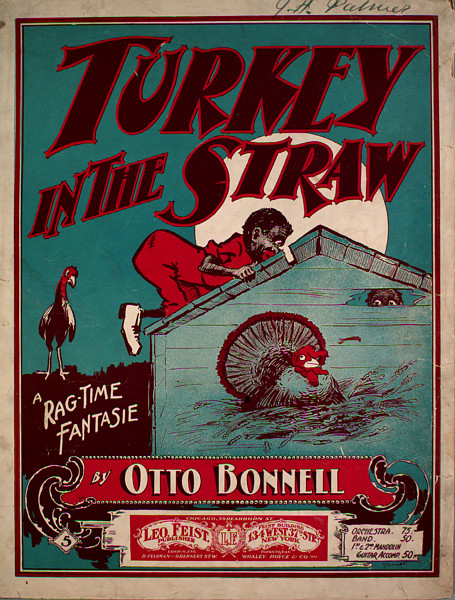
American Song # 3: Turkey in the Straw/Old Zip Coon


There is no song in American history which represents America more than "Turkey in the Straw" and there is no song which America is more ashamed of.

Everyone knows the tune "Turkey in the Straw", but in case you need reminding, here's some random YouTube fella playing it on the fiddle:


It's pretty much the perfect melody and those few notes say more about America than the entire wanking country music scene for the last 40 years. The legendary tune has existed since at least the 18th century and has its roots in irish music, but when it came over to America it became a hit on the newly arisen blackface ciruit. To cash in on the success of the ur-blackface number, "Jump Jim Crow", around 1830 the melody was first named and published as "Old Zip Coon".


I do have to say that, compared to later negro parodies, Zip Coon is actually a pretty suave-looking guy.

There is a tendency with such a well known song for people to try and "reinterpret" it when they play, but the best straightforward version of the song I've heard is by the 2nd South Carolina String Band from, oh yes, 1997. The 2nd South Carolina String Band specialise in accurate recreations of Civil War era music and their version of "Zip Coon" is pretty much as good as it gets:


The song was originally written with the chorus: "O Zip a duden duden duden zip a duden day!" Bob Dylan, eat yer heart out!

It was one of the most popular minstrel songs of its day along with the likes of "Dixie" and "Oh Susanna". In 1861, the song was published again, with new lyrics by Dan Bryant and was first called "Turkey in the Straw". This is the title most associated with it today.

Both "Old Zip Coon" and "Turkey in the Straw" are nonsense songs - there is no working class message, no racial or social message, no romance - just complete meaningless nonsense. The lyrics have been altered throughout the ages, but here's a few examples:

Did you ever go fishin'
On a warm summer day
When all the fish
Were swimmin' in the bay
With their hands in their pockets
And their pockets in their pants
Did you ever see a fishie
Do the Hootchy-Kootchy Dance?


OR

Well, if frogs had wings and snakes had hair,
And automobiles went flyin' thro' the air,
Well, if watermelons grew on a huckleberry vine,
We'd still have winter in the summer time.


OR

O it's old Suky blue skin, she is in lub wid me,
I went the udder arter noon to take a dish ob tea;
What do you tink now, Suky hab for supper,
Why chicken foot an possum heel, widout any butter.


OR

Sings posom up a gum tree an cooney in a holler,
posom up a gum tree, cooney on a stump,
posum up a gum tree, cooney on a stump,
Den over dubble trubble, Zip Coon will jump.


Some of the strangest lyrics ever written were written in the 19th century - Bob Dylan's "surreal" lyrics on the likes of "Blonde on Blonde" ain't got shit on them. A fact which Bob himself has acknowledged.

The song has entered into the public consciousness in many ways. One of the most well known of course is the classic Disney cartoon Steamboat Willie from 1928, the first Disney cartoon to use synchronised sound, in which Mickey plays the song using the organs of various animals:


Legendary stuff. The song was first recorded in the 1890's (possibly 1891!) by Billy Golden. Here's a link to public domain upload from the Internet Archive:

http://www.archive.org/details/TurkeyInTheStrawByBillyGolden1890s

Shockingly, the sound quality isn't great, although it's surprisingly good for the 19th century. Here its played in vaudeville style on the piano with Billy going mental, shrieking and laughing like a nutter. Billy Golden was one of the first great stars of the vaudeville circuit and recorded numerous popular songs.

"Turkey in the Straw" was most associated with blackface until the hillbilly scene took off; it then became most associated with that other most ridiculed American minority, the southerner and the song became a by-word for rural life and hickishness. Take a look at this music video fron 1942, by the Schnickelfritz Band:


I'm going to make a bold statement here, because I'm drunk: "Turkey in the Straw" is the GREATEST MELODY IN HUMAN HISTORY. You may think I'm crazy, but just keep listening to it. It's simple and yet its complex and its SOOOOOOOOOOOOOO catchy and memorable. Yet unlike many other folk songs, you won't find this played to an American flag, by a brass band, or sung at a political rally. The most you'll ever hear is an Ice Cream truck

Its the song that America likes to push into a corner - its a point of guilt and embarrassment, representing everything that they like to forget, like blackface minstrelry and hillbillies. It is not considered an artistic song, or an important song. It's considered lightweight and childish. But it's this shameless pretentiousness that highlights its genius. They may play "Glory, Glory Hallelujah", "Star Spangled Banner", "God Bless America", but it's "Turkey in the Straw" and "Old Zip Coon" and THAT melody that really embodies America and says everything you need to know and feel.

It is perfection. It should be treasured.

So, everyone together:

De de, de-de de, de de deh deh, deh deh deh, de, deh...

Monday, 1 February 2010

I am a billie and I live in the hills - Hillbilly Music


Around the same time in 1920 that "Crazy Blues" revealed a market for "race records" another market was realised - that of "hillbilly records", or "old-timey" music made by and made for rural white southern audiences. So, string bands, fiddlers, guitarists, banjoists and more were recorded by the bucketfull in the Southern states, playing music which they had been playing for a hundred years, but which they suddenly were able to make money from. The songs were usually traditional songs and ranged from well known standards like "Turkey in the Straw", to more obscure songs like "Mole in the Ground" and even branching out into pop songs and blues songs. Still, this was first and foremost, "folk music".

The first hillbilly record is a bit controversial - a fiddler named Don Richardson recorded "Old Zip Coon" in 1916 and some have argued the point for this being the first hillbilly record - it could well be, but I'd discount it for a number of reasons. Firstly, the record is so badly preserved that its unlistenable. Secondly, no information is known about Don Richardson, whether he was even from the south or not. Thirdly, this was released before the actual concept of the hillbilly record had been created and there were plenty of other people in vaudeville playing old-timey songs, albeit not in a traditional style. Basically, its too complicated and I will discount it for now.

So, among most scholars, the two musicians slated to have kicked off the Hillbilly record industry are Eck Robertson and Fiddlin' John Carson. Eck Robertson was born in 1887, the son of a confederate soldier; his father and grandfather were also fiddlers. Honing his skills in medicine shows across the US, his recording of "Sallie Gooden" was released on the 1st September 1922 and was not a commercial success. It is, however, one of the most amazing pieces of fiddling ever recorded. The very poor quality of the record somewhat hinders this, but you can still get the sheer virtuosity shining through:


I must note, there are better sounding copies than the YouTube version presented here. Next up was Fiddlin' John Carson. Born in 1868, he was one of the oldest hillbilly musicians to record. He was already proclaimed champion fiddler of Georgia by the time he recorded "Little Old Log Cabin In The Lane" for Okeh records in 1923. Head of Okeh, Ralph Peer, hated the record describing it as "pluperfect awful", but the 500 copies pressed sold out immediately and they suddenly realised there was a market for this kind of music available. "Little Old Cabin In The Lane" is a much recorded standard in string band and bluegrass circles as a jaunty, bouncy rave up but the original version is a slow, mystic-sounding waltz, sounding as though he were singing from a foggy mountain top:


After this, the Hillbilly scene just took off and fiddlers and old-time conventions across the south became more popular than ever. Here's a video of one such convention in which a couple of hillbillies dance like freaks to an army of banjos, fiddles and guitars:


The greatest hillbilly of them all - the man who became known as "King of the Hillbillies" was Uncle Dave Macon. Born in 1970, he was ancient old lunatic by the time his recording career kicked off in 1924 with the first hillbilly anthem: "Hill Billie Blues". Unfortunately, YouTube seems a bit sparse on Uncle Dave Macon (I will upload some when I get to making his page) so for now here's his stompin', chompin', whoopin' and a-hollerin' banjo freakout, "Way Down the Old Plank Road":


He's backed up by legendary guitar picker Sam McGee on that song - both Sam and Dave will require their own pages, so I won't go into great detail on them here.

The next big thing to get recorded on the Hillbilly scene were the string bands. These were bands of fiddlers, banjoists and guitarists who rocked out fast, loud and noisy old-timey songs with a reckless abandon. Many of the original solo artists like Uncle Dave and Fiddlin' John formed string bands soon after their careers took off. They were often done with family members and usually were secondary to their main jobs. There were a shiteload of string bands in the 1920's - with Uncle Dave's Fruit Jar Drinkers being my personal favourite - but the quintessential string band was almost certainly the Skillet Lickers.


They were formed by the musically inept mental case Gid Tanner, who couldn't read a note of music, but memorised around 5000 songs and could barely play his fiddle, but was expert at making high-pitched screeching noises and could allegedly turn his head 180 degrees and bend it so far back that he looked headless. All useful skills. More ssubstantial was virtuoso blind guitarist, Riley Puckett - Puckett, like most hillbilly guitarists, played the guitar with a flatpick and used it mostly for bass lines and strumming. He also provided vocals. The other most important member was Clayton McMichen who was a virtuoso fiddle player. Other band members came and went but these were the most important. The majority of the Skillet Lickers song tended towards the more well-known side, at least by the standards of old-time music. They even played bloody "Old MacDonald" for christ's sake. One of their best recordings is that of the oft-covered Civil War song "Soldier's Joy". Their 1929 recording of this is maybe the definitive version:


Maybe the greatest moment is the chorus when the duelling fiddles just take off into the slightly-dissonant stratosphere. The Skillet Lickers had internal conflicts - Gid Tanner wanted to keep a traditionalist stance, while Clayton McMichen wanted to play more ragtime and jazz. McMichen did get his wish occasionally resulting in odd covers like the jazz standard "Darktown Strutters Ball", but generally they were traditionalists. Another classic recording is their version of "Bully of the Town" from 1926. Compare this to Mary Irwin's more racially slurring version from 1907 as I posted it in the ragtime post:


One of the biggest hillbilly stars of the time was Charlie Poole. Charlie Poole, who seemed unable to take a photo without looking like a psychopath...


...fronted one of the most popular string bands, the North Carolina Ramblers and created a unique hillbilly sound based on bluesy fiddle playing and Charlie's unusual method of banjo fingerpicking. They did less mainstream traditional songs than the Skillet Lickers although one of the more well known is their cover of "Didn't He Ramble" from 1929:


He could also do more sentimental songs like "Goodbye Mary Dear" from 1929:


Charlie Poole died in 1931 after a...wait for it...13 week bender! Iggy Pop, eat yer heart out! He had just been informed that he had been hired to do some music for Hollywood films and presumably got a bit carried a way...

The term "Hillbilly Music" was used to refer to country music up until the 1950s - even Hank Williams was once referred to as hillbilly music. In retrospect though, hillbilly music can been seen to have burnt away around the mid 30s, with the onset of more polished country music genres like Western Swing, Bluegrass and Cowboy music. Both Uncle Dave Macon and the Skillet Lickers continued for decades after, but otherwise there was no real revitalisation of the music and there hasn't really been to this day.

Perhaps it's because, more than any other kind of music, hillbilly music comes from true authenticity - unless you spent your time drinking moonshine, swinging on porch swings and hollerin' in the 1920's, it's hard to imitate without coming across as patronising and insincere.

To finish, here's me playing a classic hillbilly number, "Cripple Creek" with clawhammer banjo. It starts off slow, but picks up speed:


Gang ploose, muds!