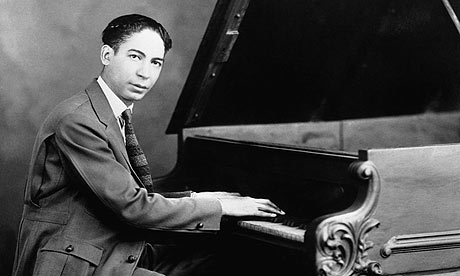
A lot of people have laid claim to the title King of Jazz: Buddy Bolden, its supposed father, Freddie Keppard, his successor, Nick LaRocca, the first man to record it and Paul Whiteman, the first man to introduce to a large white audience. Still, as far I'm concerned, in the 1920's there were only two men who could really lay claim to the title: Louis Armstrong and Jelly Roll Morton.
Jelly Roll Morton was a New Orleans pianist, whose real name was Ferdinand Joseph LaMothe. Born in 1884 (or 1889 as some sources state) into a Creole community, he was surrounded by the sounds of gospel, early blues, ragtime and folk songs that made up the rich culture of New Orleans at the time. By the age of 14, influenced by the likes of Scott Joplin, Buddy Bolden and Tony Jackson, he was playing in brothels to earn his keep and became regarded as one of the best pianists in Storyville (the New Orleans red light district). In 1904 he joined a travelling minstrel show and set out across America.
Jelly Roll Morton was the first true Jazz composer. In 1915, he published the sheet music for what is arguably the first Jazz song ever written, "The Original Jelly Roll Blues" - it is a pretty incredible composition, with elements of ragtime, blues with, as Jelly Roll called it, the "Spanish tinge" but not really sounding like any of them; the very essence of Jazz. Although Jazz musicians had existed before this, the publication of "The Original Jelly Roll Blues" marked the first time that Jazz was introduced into any kind of mainstream culture.

Here was something really new - Jelly Roll Morton was an educated musician who was steeped in traditional music and amalgamated all his influences into a truly modern music which go onto become America's greatest musical artform. Everything that happened after, from Dixieland to Swing, to Big Band, to Boogie, to Bebop, to Jump Blues, to Rock 'n Roll, to Free Jazz and so on, could not have happened with out "The Original Jelly Roll Blues". Here's a recording by pianist Jim Hession:
Ironically, for all this, Jelly Roll Morton didn't make any recordings until 1923 and these were a mixture of piano solos and band recordings. The piano recordings are interesting for historical purposes, but this was before the advent of electrical recording, which occured around 1926, and so the recordings are very tinny and not particularly enjoyable. The same goes for the band recordings, which are even worse - he didn't have a real band at the time and they sound bland and uninspired.
Jelly Roll must realised this himself, because in 1926 he put together his Red Hot Peppers, one of the best Jazz bands of the era. Less jammy then earlier Jazz bands like King Olivers and less improvisational than Louis Armstrong's Hot Fives, the Red Hot Peppers were tight-as-a-pussy-cat, virtuoistic, but wild and uninhibited. Featuring the great Kid Ory on trombone and Johnny St. Cyr on banjo among others, there recordings are also some of the best sounding too - he must have shelled out for better recording equipment. One of their best recordings is "Black Bottom Stomp" from 1926 - a wild dance number which features every band member going at it like a muthah, but through which the compositional genius of Jelly Roll Morton (who is on piano) shines through:
They all so recorded a full band arrangement of the "The Original Jelly Roll Blues" which is not only a brilliant recording, but which is a great example of how Jelly Roll Morton was able to transpose his piano playing into an ensemble arrangement:
The Red Hot Peppers made a lot of great recordings until he disbanded them in 1930. Jelly Roll Morton lay low for most of the 1930's - his Hot style of Jazz was being replaced by the smoother sound of the Big Bands and Swing. Although he did record intermittently in the 1930's, his most important recordings were with legendary folklorist Alan Lomax in 1938, for the library of congress. Not released for decades, Alan Lomax made hours and hours of recordings of Jelly Roll discussing Jazz, Ragtime, New Orleans, folk music, classical music and anything else that came to mind.

During these sessions, he got a bit tipsy and recorded a few "dirty" songs, which he had played in brothels in New Orleans back in the 19th century, but which until then he had no hope of recording. They're interesting simply because they prove that this kind of language was not invented in the 70's. Take this recording of "Dirty Dozen" which includes massive amounts of expletives as well as homosexuality, bestiality and whatever other fun things he could think of:
Lovely stuff. Less abrasive perhaps, was his recording of the traditional blues song, "Hesitation Blues":
Around 1939, he put together another band, his New Orleans Jazzmen and recorded a number of more bluesy, more vocals-based songs. They were not commercially successful, but they are very good. He recorded two of his most covered songs during this session, the "Funky Butt" update, "Buddy Bolden's Blues" and "Winin' Boy Blues":
Jelly Roll Morton died in 1941 from complications involving asthma. In later years he gained reputation as a bit of an arrogant bastard - claiming to have invented Jazz in 1902 and slagging of W.C. Handy in a magazine, he gained an image of a man bitter at what he saw as not getting his dues. Well, Jelly Roll Morton may not have invented Jazz outright, but he was probably it most influential proponent and the man who turned it into a genuine artform. He was to Jazz what Scott Joplin was to Ragtime and W.C. Handy was to the Blues. Not to mention that, unlike either of these two, he was also one of its great performers and his Red Hot Pepper recordings are essentially flawless.
Chang goose, muds...

