Showing posts with label jazz. Show all posts

Tuesday, 16 February 2010

On to more Spiritual matters...


No-one would deny that Christianity has contributed a huge amount to musical culture of the world. Afterall, written music has its origins there and hymns have made up most of the backbone of modern music. Still, I personally believe that the negro spiritual has been the best expression of christianity through music. Maybe its the simple unpretentiousness of them or their association with slavery - thus lending a certain authenticity to the messages and morals - or maybe, I dunno, I just don't like white people's religious music. Regardless, they make up one of the greatest repetoires of folk songs in history and are perhaps more important than any other genre of the 18th and 19th century.

Actually, I'm going to start this post with a song that was not originally a negro spiritual, or even an American song, but which was later inaliably identified with the genre. That song is, of course, "Amazing Grace".

Now if you're one of those genuinely strange people who doesn't know this song, here's a recording by Judy Collins from the early 70's. Generally, I don't like Judy Collins, because she represents a horribly, horribly polished and fake branch of so-called "folk music", but her recording of this, backed by a choir, is pretty perfect:


"Amazing Grace" is one of the oldest songs I'll be dealing with on this blog,it was published in 1779 by ex-slave trader John Newton. This is significant - there were absolutely shiteloads of hymns written in the 17th and 18th century and if we were simply dealing with Christian hymns that influenced negro spirituals I could come up with any number by the likes of Isaac Watts. What makes "Amazing Grace" significant is that it was written by an ex-slave trade trader in (allegedly) a fit of religious and moral guilt over his profession and the song became something of an anthem for the whole abolitionist movement and later for enslaved African-Americans.


The symbol used by the Quakers and other abolitionists in Britain in the 18th century - "Am I not a man and a brother?"

Ironically, this most theistically uplifting of musical genres grew out of cultural opression and repression - when African slaves were brought to America, all elements of their African culture and heritage was obliterated; they were all brought under the arm of Christianity and had any attempts at breaking into African songs or rituals forcefully beaten out of them. When sitting in church, benches would be pushed close together to prevent the slaves from getting up and dancing.

To quote negrospirituals.com:

Rural slaves used to stay after the regular worship services, in churches or in plantation “praise houses”, for singing and dancing. But, slaveholders did not allow dancing and playing drums, as usual in Africa. They also had meetings at secret places (“camp meetings”, “bush meetings”), because they needed to meet one another and share their joys, pains and hopes. In rural meetings, thousands slaves were gathered and listened to itinerant preachers, and sang spirituals, for hours. In the late 1700s, they sang the precursors of spirituals, which were called “corn ditties”.

However, the very basis of Christianity condemns slavery as a sin and it is this fact that eventually made Christianity the enemy of slavery and a tool for its abolition. Trying to provide a timeline for negro spirituals is practically impossible, since, even compared to white folk songs, documentation of the songs is practically non-existant. However, there were a few books published in the mid 19th century that were collections of negro slave songs, often including spirituals, the first and most significant being "Slave Songs Of The United States" in 1867.


If you want to actually read the book, here's a full scan of it:

http://docsouth.unc.edu/church/allen/allen.html

Not a lot of the songs documented are that well known today, but there are a few that are pretty famous. The most famous is probably "Michael, Row The Boat Ashore". It was big during the American 1960's folk revival and, as such, here's a version by Pete Seeger from 1963:


Pete can get on my tits sometimes with his often patronising attitude, but this is pretty cool. Another well known song from the book is "Nobody Knows the Trouble I Seen", sung here by legendary "voice of God" Paul Robeson:


One of the most popular and lasting negro spirituals is "Go Down, Moses", also known as "Let My People Go". Unlike a lot of spirituals, the song is not jubilant and uplifting, but sombre and ominous - the song's relevance has no doubt been emphasised due to the obvious parallels made between the plight of the Israelites and African-American slaves. I mean, it is one of the few slave songs that actually contains the phrase "Let my people go" and so has been put forward as one of the great songs of defiance and determination. The song was first published in 1872 by the Fisk Jubilee Singers, the premiere black vocal group of the era, but some sources have dated the song as having been sung as early as 1853. One of the best versions of the song is from Preston Sturges' 1941 existentialist screwball comedy, "Sullivan's Travels":


Probably the most famous negro spiritual is "Swing Low, Sweet Chariot". Interestingly, the song had an official author, Wallis Willis, a freedman (newly emancipated slave) who composed the song sometime before 1862. Whether he based it on an earlier song he had heard or actually thought it up himself doesn't really matter, though - the song became basically the anthem for African-Americans and arguably remains so until this day, although I'd like to suggest it has more universal status. It has been suggested that the lyrics to the song referenced the "underground railroad", the secret means for slaves to escape to the freed states. It was popularised by the Fisk Jubilee Singers starting in the 1870's and took from there. If, somehow, you haven't actually heard this song, you're probably sectioned. But still, here's a version by vocalist(and clearly a massive Paul Robeson fan) Kevin Maynor. Trying to find decent versions of this song is hard, bytheway, because almost all the versions I see are either "clever reinterpretations" (shite) or sung by overdramatic "soulful" singers (really shite):


After the abolition of slavery, the most famous singers of negro spirituals were the Fisk Jubilee Singers, a group of African-American students from Fisk University who formed in 1871 as something of reaction against the blackface minstrel shows who claimed to bring the "authentic" sound of the freed black slaves to the stage.


The Fisk Singers were an acapella vocal group whose dignified and, admittedly, middle-class renditions of negro songs (and a few Stephen Foster songs) provoked both praise and criticism across America and Europe. Probably for the same reason in both cases - they didn't confirmed to the stereotyped image of blacks that had been instilled in people's minds. They still exist today as a group, albeit (shockingly) with none of the original members; it is something of a tradition in Fisk University. The original Fisk singers made recordings as early as the turn of the century, but they often sound very old and creaky today. A lot of them can be found public domain on the internet, but here's a very good recording made in 1926 of "Keep A' Inchin' Along":


With the birth of various new recording markets, spirituals became widely spread throughout popular culture. Even genres like the supposedly Satanic medium of the blues and the supposedly white-washed country music recorded a lot of negro spirituals.

Artists like Blind Willie Johnson and the Reverend Gary Davis who were usually (and inaccurately) labelled as country blues artists had repetoire composed almost entirely of religious material, albeit played with a bluesy, raggy guitar accompaniment. Here's Reverend Gary Davis playing "Children of Zion" and looking badass on Pete Seeger's Rainbow Quest in the mid 1960's:


And take this beautiful version of "All God's Chillun Got Wings" by cowboy vocal group, the Sons Of The Pioneers - a great defence against the percieved image of country music as white washed or racist:


In the 1940's, Thomas A. Dorsey combined the negro spiritual with jazz, R&B and pop influences and created gospel music. Gospel music is often thought of as interchangable with the negro spiritual, but it really is a very different kind of music - take a listen to this recording of the Golden Gate Quartet, one of the most popular gospel groups of the 30',s 40's and 50's singing the negro spiritual, "Joshua Fit The Battle" in the gospel style:


Of course, in the 20th century, negro spirituals had their biggest revival during the civil rights movements, but that's really an issue for another time....

Twang goose, muds!

Sunday, 31 January 2010

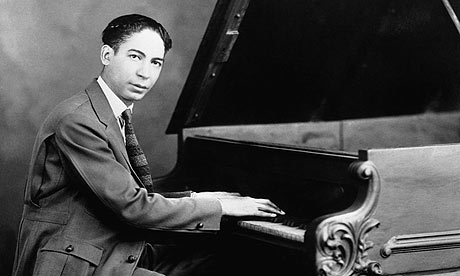
American Artist No. 1: Jelly Roll Morton


A lot of people have laid claim to the title King of Jazz: Buddy Bolden, its supposed father, Freddie Keppard, his successor, Nick LaRocca, the first man to record it and Paul Whiteman, the first man to introduce to a large white audience. Still, as far I'm concerned, in the 1920's there were only two men who could really lay claim to the title: Louis Armstrong and Jelly Roll Morton.

Jelly Roll Morton was a New Orleans pianist, whose real name was Ferdinand Joseph LaMothe. Born in 1884 (or 1889 as some sources state) into a Creole community, he was surrounded by the sounds of gospel, early blues, ragtime and folk songs that made up the rich culture of New Orleans at the time. By the age of 14, influenced by the likes of Scott Joplin, Buddy Bolden and Tony Jackson, he was playing in brothels to earn his keep and became regarded as one of the best pianists in Storyville (the New Orleans red light district). In 1904 he joined a travelling minstrel show and set out across America.

Jelly Roll Morton was the first true Jazz composer. In 1915, he published the sheet music for what is arguably the first Jazz song ever written, "The Original Jelly Roll Blues" - it is a pretty incredible composition, with elements of ragtime, blues with, as Jelly Roll called it, the "Spanish tinge" but not really sounding like any of them; the very essence of Jazz. Although Jazz musicians had existed before this, the publication of "The Original Jelly Roll Blues" marked the first time that Jazz was introduced into any kind of mainstream culture.


Here was something really new - Jelly Roll Morton was an educated musician who was steeped in traditional music and amalgamated all his influences into a truly modern music which go onto become America's greatest musical artform. Everything that happened after, from Dixieland to Swing, to Big Band, to Boogie, to Bebop, to Jump Blues, to Rock 'n Roll, to Free Jazz and so on, could not have happened with out "The Original Jelly Roll Blues". Here's a recording by pianist Jim Hession:


Ironically, for all this, Jelly Roll Morton didn't make any recordings until 1923 and these were a mixture of piano solos and band recordings. The piano recordings are interesting for historical purposes, but this was before the advent of electrical recording, which occured around 1926, and so the recordings are very tinny and not particularly enjoyable. The same goes for the band recordings, which are even worse - he didn't have a real band at the time and they sound bland and uninspired.

Jelly Roll must realised this himself, because in 1926 he put together his Red Hot Peppers, one of the best Jazz bands of the era. Less jammy then earlier Jazz bands like King Olivers and less improvisational than Louis Armstrong's Hot Fives, the Red Hot Peppers were tight-as-a-pussy-cat, virtuoistic, but wild and uninhibited. Featuring the great Kid Ory on trombone and Johnny St. Cyr on banjo among others, there recordings are also some of the best sounding too - he must have shelled out for better recording equipment. One of their best recordings is "Black Bottom Stomp" from 1926 - a wild dance number which features every band member going at it like a muthah, but through which the compositional genius of Jelly Roll Morton (who is on piano) shines through:


They all so recorded a full band arrangement of the "The Original Jelly Roll Blues" which is not only a brilliant recording, but which is a great example of how Jelly Roll Morton was able to transpose his piano playing into an ensemble arrangement:


The Red Hot Peppers made a lot of great recordings until he disbanded them in 1930. Jelly Roll Morton lay low for most of the 1930's - his Hot style of Jazz was being replaced by the smoother sound of the Big Bands and Swing. Although he did record intermittently in the 1930's, his most important recordings were with legendary folklorist Alan Lomax in 1938, for the library of congress. Not released for decades, Alan Lomax made hours and hours of recordings of Jelly Roll discussing Jazz, Ragtime, New Orleans, folk music, classical music and anything else that came to mind.


During these sessions, he got a bit tipsy and recorded a few "dirty" songs, which he had played in brothels in New Orleans back in the 19th century, but which until then he had no hope of recording. They're interesting simply because they prove that this kind of language was not invented in the 70's. Take this recording of "Dirty Dozen" which includes massive amounts of expletives as well as homosexuality, bestiality and whatever other fun things he could think of:


Lovely stuff. Less abrasive perhaps, was his recording of the traditional blues song, "Hesitation Blues":


Around 1939, he put together another band, his New Orleans Jazzmen and recorded a number of more bluesy, more vocals-based songs. They were not commercially successful, but they are very good. He recorded two of his most covered songs during this session, the "Funky Butt" update, "Buddy Bolden's Blues" and "Winin' Boy Blues":


Jelly Roll Morton died in 1941 from complications involving asthma. In later years he gained reputation as a bit of an arrogant bastard - claiming to have invented Jazz in 1902 and slagging of W.C. Handy in a magazine, he gained an image of a man bitter at what he saw as not getting his dues. Well, Jelly Roll Morton may not have invented Jazz outright, but he was probably it most influential proponent and the man who turned it into a genuine artform. He was to Jazz what Scott Joplin was to Ragtime and W.C. Handy was to the Blues. Not to mention that, unlike either of these two, he was also one of its great performers and his Red Hot Pepper recordings are essentially flawless.

Chang goose, muds...

Thursday, 28 January 2010

American Song # 1: Funky Butt

Hey, it's me! The younger, hairier, more foul-mouthed, slightly less famous answer Pete Seeger!

Today we deal with the song, "Funky Butt". This is one of those casually obscene songs popular in New Orleans around the turn of the century, originating in the many whorehouses and illicit clubs around Storyville. In this sense, the word "funky" means "smelly" basically and the song is presumably about either farting or sweating. I suppose it could probably be the first piece of music where the term funky was a applied though - Ray Charles eat yer heart out...

Anyway, although no-one knows for sure who wrote the song, it was most associated with Buddy Bolden, the supposed Father of Jazz.


Buddy Bolden's band were allegedly playing jazz as early as the 1890's and his cornet playing was said to audible for miles around when he played. Some people, notable Jelly Roll Morton, have argued that he was merely a very loud ragtime musician and since there are no existing recording of Buddy, we'll never really know. Jelly Roll Morton adapted "Funky Butt" into the slightly sanitised "Buddy Bolden's Blues" or "I Thought I Heard Buddy Bolden Say". Here's a recording of him playing it from around 1938:


Here's a bunch of guys whom I have never heard of playing a slightly more modernised very of "Funky Butt", albeit with the original title:


And here's ME playing and singing it on the guitar! Loosely based on the version by Mississippi John Hurt:


Buddy Bolden, like everyone apparently, went mad and was sent to a mental institute in 1907, dying there in 1931. He missed out on the Jazz age, but his influence spread directly to the next generation of musicians like Freddie Keppard, Jelly Roll Morton and King Oliver. There is a film being made about him starring Anthony Mackie set for release in 2010:

http://www.imdb.com/title/tt0858419/

Anyway, until next time, shag loose, hangers...

Wednesday, 27 January 2010

So, let's talk about Ragtime!

Let's talk about RAGTIME!!!


Ragtime is maybe the most misunderstood genre in American music. Arising in the 19th century in black urban communities, ragtime was one of the first truly indiginous music forms to arise in America - involving syncopation, seventh chords, back-beat and lots of other goodies that I'm not technically gifted enough to explain, it was essentially a form of very catchy dance music. Although popular for many years in vaudeville and medicine show circles, the first published form of ragtime was the, heh, Coon song.

Coon songs were basically songs written by both black and white ragtime composers which stereotyped, ridiculed and charicatured the lifestyles and society of black people. I suppose at the time a lot of people thought they were accurate representations of black society, but today they can only be percieved as bizarre and offensive. Still, you've got to allow for historical perspective - it's not as though they're white power songs, they're just hopelessly dated in their ideas.

One of the catchiest was Mary Irwin's (most famous as the first woman to kiss on film) "The Bully Song" from 1895. This song was later sanitised as the folk song "Bully of the Town, but here it is in it's original glory, recorded in 1907; you may shit yourself when you hear the lyrics...


At the turn of the century, however, a new form of ragtime arose now known as classic ragtime. The leading proponents of this were Joseph Lamb, James Scott, Tom Turpin and, most famously, Scott Joplin, who is maybe America's greatest composer. The main thing Scott Joplin and his ilk brought to the table was a classical influence - their rags are considerably more complex and harmonically interesting then coon songs or country rags. The first published rag by an African-American was Tom Turpin's Harlem Rag in 1897, but inarguably the quintessential ragtime composition, perhaps ever, is Maple Leaf Rag by Scott Joplin from 1899. Joplin never lived long enough to record anything properly, but he did make piano rolls - programmed sheets of paper which record the pianist's playing for it then to played back on a player piano, motorised pianos like the ones you see in old Tom and Jerry cartoons. Anyway, here's him playing America's answer to Ode to Joy:


Scott Joplin is most famous to today's music lovers through the film, The Sting, where various compositions of his provided the soundtrack. Like most people in his position, Joplin caught syphilis, went mad and died in a mental hospital in 1917. The ragtime era produced few recording dues to both an inability to record it properly and the unwillingness for companies to record African-Americans but there are a few gems that made it through. Perhaps the greatest ragtime musician of the era was Vess L. Ossman, a virtuoso banjo player who, with his ragtime band, produced some surprisingly well recorded, extremely catchy and very intricate recordings. Here's a recording from 1909 of the classic St. Louis Tickle:


What happened to ragtime? One word: Jazz. Ragtime fell out of popularity and was almost completely replaced in public mind by jazz. Even old ragtime musicians dropped their original style in favour of jazzing it up. Jazz introduced improvisation, blues, energy and dispersed with the plantation associations that still plagued ragtime. By the mid 1920's, ragtime was all but gone in the public mind. However, ragtime compositions still popped up in the repetoire of jazz bands. Take Louis Armstrong's 1927 recording of the 1914 "12th Street Rag":


And ragtime also found its way into a new medium: the guitar. Blind Blake, arguably the greatest guitarist of all time, was known as the Kind of Ragtime Guitar and songs like "Southern Rag" from 1927 adapted the piano style to the 6-string:


So, that's ragtime for you!

Various recordings are available from this site:

http://www.archive.org/

Anyway, hang loose bloods!

Tuesday, 26 January 2010

The first post is always the hardest...

...I have absolutely nothing to say.

This blog centres around the old, weird America. It brings hot jazz, negro spirituals, civil war music, old-time folk, country, bluegrass, blues, boogie, film noir, screwball comedies, surrealism, gangsters, universal horrors and all things bright and beautiful...

It may just be God's own blog, but you won't here me saying that...

For now, here's Grandpa Jones!